


How to Measure Metal Pipe Wall Thickness with an Ultrasonic Thickness Gauge
#Service Case ·2026-07-15 10:22:07


During the service life of metal pipes, corrosion, wear, and other forms of damage may occur either across the entire pipe or in specific areas. As the pipe wall gradually becomes thinner, local wall loss can affect the safe operation of the pipeline. For this reason, wall thickness measurement is an important part of routine metal pipe inspection. The main purpose is to monitor wall thinning, estimate the thinning rate, and evaluate the remaining service life of the pipe. There are several ways to measure pipe wall thickness, and for most metal pipe applications, a metal pipe thickness gauge is one of the most commonly used tools. So how does a metal pipe thickness gauge measure the wall thickness of metal pipes?
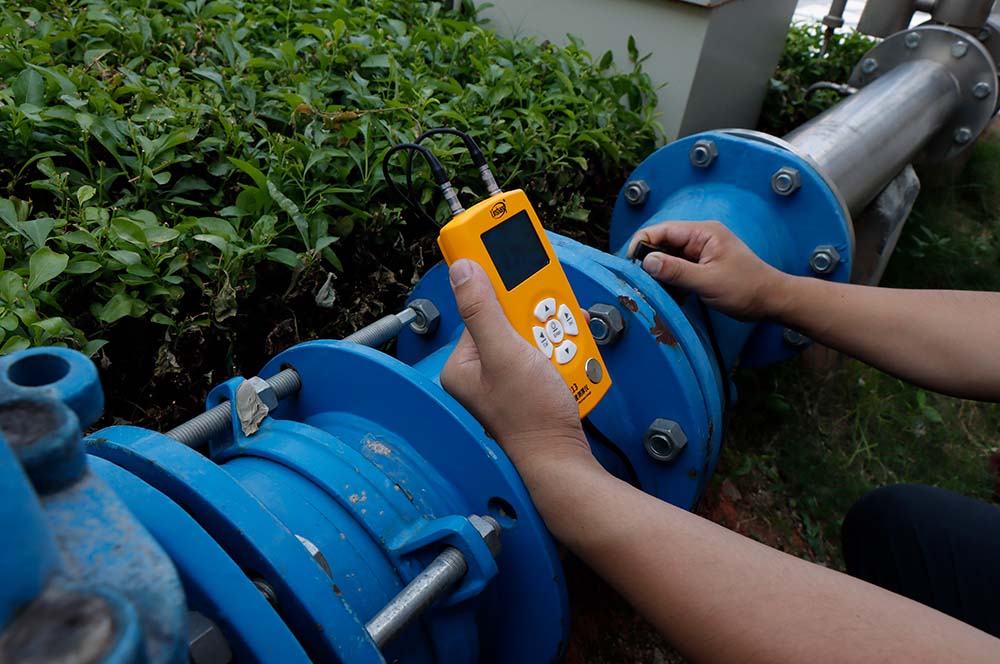
Wall thickness measurement of metal pipes
Metal pipe wall thickness measurement method
1. Metal pipe thickness gauge
A metal pipe thickness gauge, also known as an ultrasonic thickness gauge, measures pipe wall thickness by calculating the round-trip travel time of ultrasonic pulses through the metal material. Linshang ultrasonic thickness gauges provide three sound velocity setting methods: selecting the sound velocity according to the known material, calculating the sound velocity based on a known thickness, or manually entering the sound velocity. These three settings allow the instrument to be used for a wide range of metal pipe materials.
Before measurement, the surface of the metal pipe should be properly prepared. Oxide layers, rust, scale, and other surface contaminants should be removed to ensure that the measuring surface is clean and flat. During measurement, a suitable couplant should be applied to the pipe surface, and the dual-element probe should be placed steadily on the measuring point, keeping proper contact with the pipe surface.
2. Ultrasonic flaw detector
When an ultrasonic flaw detector is used for thickness measurement, a high-frequency small-diameter longitudinal wave straight probe is usually selected. If the coupling condition on the pipe surface is not ideal, an ultrasonic flaw detector may still provide useful inspection results. By scanning the pipe wall with a suitable probe, the operator can make a qualitative assessment of the wall condition based on the waveform characteristics.
When the pipe wall is uniform and smooth without obvious thinning, the ultrasonic echoes are evenly spaced, and the amplitude decreases in a regular pattern. The spacing between adjacent echoes represents the pipe wall thickness. If the inner wall has serious corrosion or other defects, the waveform will become more irregular, and the signal will change noticeably as the probe moves across the pipe surface.
3. Radiography method
Radiography cannot directly provide a quantified wall thickness value in the same way as an ultrasonic thickness gauge, but it can visually show the shape, size, and density of defects on the inner wall of the pipe. With the help of a grooved reference block, it can be used to estimate the depth of wall thinning and evaluate the severity of local pipe wear.
However, radiographic testing is more complex, takes longer to complete, and involves higher inspection costs. Therefore, it is generally used as a supplementary method when ultrasonic testing cannot clearly confirm whether wall thinning exists.
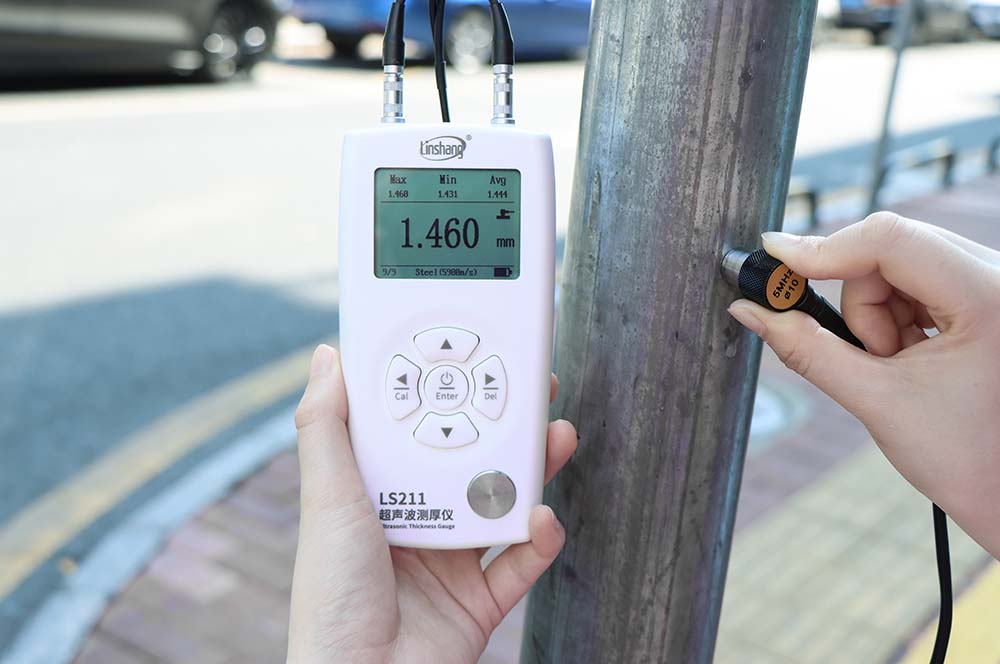
Metal pipe thickness gauge
Advantages of metal pipe thickness gauge
1. The instrument is compact and easy to carry. With only a few buttons, it is simple to operate and easy for new users to get started.
2. The measurement response is fast, and the result can be displayed quickly on the digital screen.
3. It offers high accuracy and a wide measuring range.
4. With the QC judgment function, users can set upper and lower limit values independently, allowing quick judgment of whether the pipe wall thickness meets the required standard.
The above is an overview of common methods for measuring metal pipe wall thickness. For routine pipe wall thickness inspection, a Linshang metal pipe thickness gauge is a practical choice. With reliable accuracy, three sound velocity setting methods, and two measurement modes for data statistics and QC judgment, it can meet the needs of many metal pipe inspection applications and help users carry out wall thickness measurement more efficiently.